

When OpenAI introduced the GPT-6.2 model generation, it solidified a deliberate architectural fork in frontier AI: dividing top-tier capabilities between GPT-6.2 Astra (gpt-6.2-astra) and GPT-6.2 Sol (gpt-6.2-sol). Instead of forcing developers into a single monolithic model or a stripped-down mini variant, OpenAI engineered two distinct engines tailored for fundamentally different operational bottlenecks.
Choosing between GPT-6.2 Astra vs Sol is not a question of which model is universally "smarter"—it is an optimization problem between reasoning depth, API token burn, and loop latency. Here is a definitive, unvarnished comparison based on official developer specifications, Artificial Analysis intelligence tracking, and hands-on production tests across software engineering and multimodal prompt pipelines.
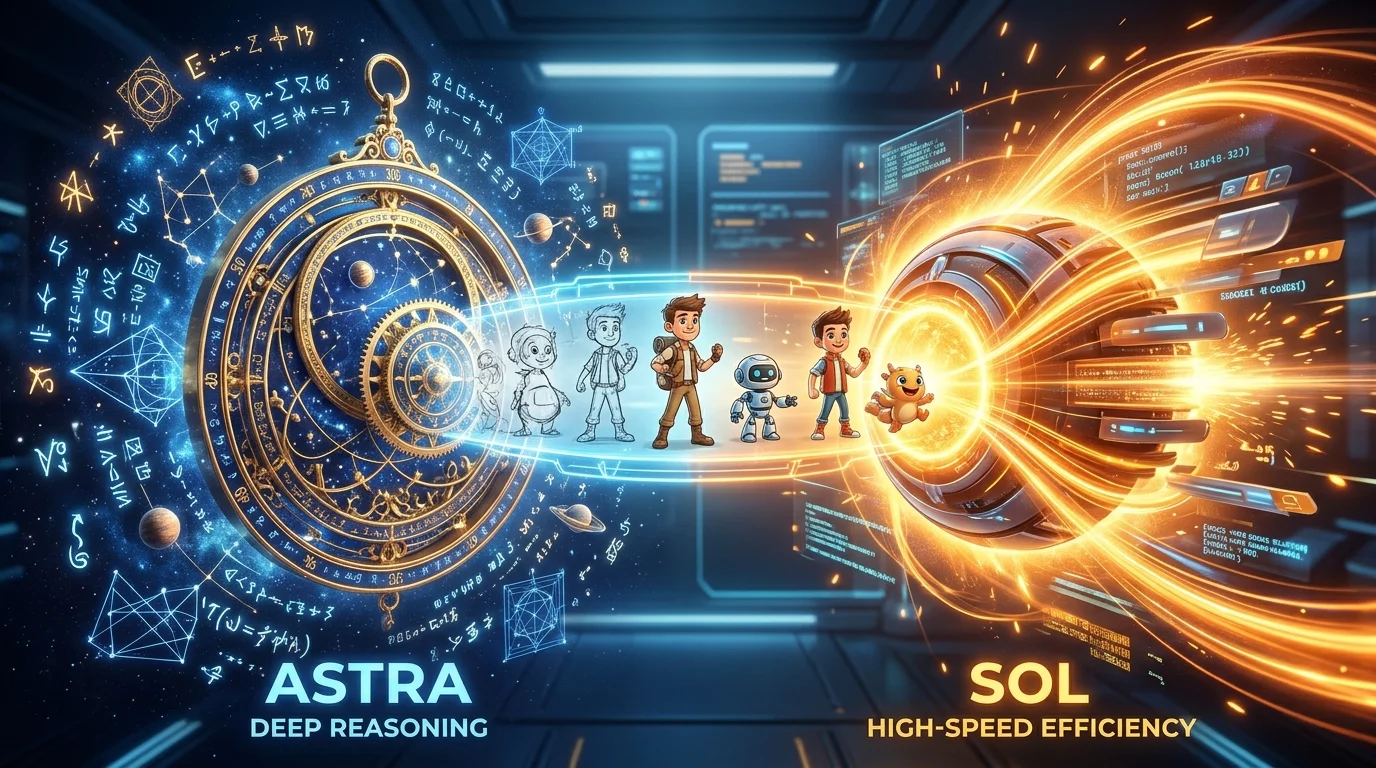
Direct Verdict: Which Engine Should You Route To?
The Standalone Answer: Choose GPT-6.2 Astra ($8/MTok in, $40/MTok out) when managing massive multi-file codebase refactoring, autonomous multi-turn agent hierarchies, or high-stakes mathematical and CAD reasoning where a single hallucination causes cascading failures. Choose GPT-6.2 Sol ($2/MTok in, $10/MTok out) for everyday coding, unit testing, high-throughput text workflows, and prompt engineering—delivering 85% to 90% of Astra's practical capability at 75% lower cost.
- Deploy Astra as the "Lead Architect": strategic planning, system specifications, ambiguous requirements, and final verification reviews.
- Deploy Sol as the "Continuous Engine": routine development, test suite execution, creative dialogue generation, and autonomous iteration loops.
Specifications and API Rate Comparison Matrix
The financial and operational differences between Astra and Sol define how systems must be architected. The table below presents verified figures from OpenAI's Responses API documentation and developer releases.
| Metric / Specification | GPT-6.2 Astra (gpt-6.2-astra) | GPT-6.2 Sol (gpt-6.2-sol) | Architectural Implication |
|---|---|---|---|
| Model Tier | Frontier Flagship & Deep Reasoning | High-Efficiency Production Daily | Astra targets hardest problems; Sol handles throughput |
| Standard Input Cost | $8.00 per 1M tokens | $2.00 per 1M tokens | Sol is 75% cheaper on fresh prompt ingress |
| Standard Output Cost | $40.00 per 1M tokens | $10.00 per 1M tokens | Sol saves $30.00 per 1M tokens on completion output |
| Cached Input Cost | $0.40 per 1M tokens | Standard discount applies | Astra's 95% cache discount offsets cost in heavy agent sessions |
| Reasoning Effort Control | Supported (low, medium, high) | Supported (low, medium, high) | Fine-grained compute budgeting available on both models |
| Ultrafast Latency Mode | Supported | Supported | Both can run latency-optimized for interactive web UI |
| Safety Self-Improvement | High Threshold Met (OpenAI First) | Standard Alignment Tier | Astra exhibits superior self-correction capabilities |
| Ideal Operational Role | System Architect / Core Planner | Task Executor / Fast Storyteller | Natural hybrid pair for production agent swarms |
Technical Divergence: Deep Reasoning vs. Execution Velocity
Understanding how these models process tokens reveals why price tags tell only half the story.
1. GPT-6.2 Astra: Frontier Verification and Structural Reasoning
GPT-6.2 Astra was trained with dense reasoning tokens allocated toward hypothesis testing and verification before generating output. According to evaluations across benchmarks like Epoch AI's ECI and complex physics simulations (such as the CritPt benchmark), Astra handles ambiguity by stress-testing alternative pathways.
Key technical characteristics:
- First-Pass Reliability: On multi-dependency engineering tasks, Astra exhibits remarkably low regression rates. When modifying legacy codebases, it catches collateral side effects that lighter models overlook.
- Agentic Loop Management: In recursive sub-agent architectures, Astra serves as a reliable coordinator because it tracks conversational state and sub-task contracts across long scratchpads without context drift.
- Autonomous Error Correction: Astra is the first external model designated under OpenAI's Preparedness Framework as meeting the High threshold for autonomous software and AI self-improvement, reflecting its ability to diagnose and repair subtle runtime anomalies.
2. GPT-6.2 Sol: The High-Throughput Everyday Workhorse
GPT-6.2 Sol is not a compressed "toy" model; it is an aggressively optimized enterprise workhorse. OpenAI maintained Sol's pricing at the exact rate card of GPT-6.1 Sol while substantially narrowing the intelligence delta against top-tier frontier models.
Key technical characteristics:
- Token Velocity: In benchmark streaming tests, Sol consistently delivers tokens 1.8x to 2.4x faster than Astra under standard compute allocations, making it the preferred backend for user-facing interactive apps.
- Everyday Code Parity: On routine tasks—writing TypeScript interfaces, implementing React hooks, generating database schemas, or debugging HTTP status handling—Sol performs with near-zero practical divergence from Astra.
- Economical Iteration: At $2 per million input tokens, developers can afford extensive automated test-driven development (TDD) cycles, running 20 to 30 continuous agent iterations for the price of a single Astra pass.

Token Economics: When Does Astra Actually Become Cheaper?
A common trap in API evaluation is looking exclusively at baseline token prices ($8 vs $2). In long-running autonomous workflows, OpenAI's Prompt Caching dynamics fundamentally alter unit economics.
The Agentic Caching Paradox
OpenAI aggressively slashed Astra's cached input price down to $0.40 per million tokens (a 95% reduction from baseline $8.00). In a multi-agent coding session:
- The developer loads a 150,000-token repository context into memory.
- The agent executes 30 sequential tool calls, reading files, modifying lines, and validating tests.
- Every subsequent call hits cached tokens.
If an architecture achieves a >90% cache hit rate across a massive static context, Astra's input cost can actually drop below Sol's non-cached operational cost under specific batch scenarios. However, for dynamic, one-off prompts with low cache reuse, Sol remains overwhelmingly more economical.
Multimodal Synergy: Pairing GPT-6.2 with Visual Generation Models
In creative production pipelines—such as AI Cartoon Generator—frontier reasoning models are rarely used in total isolation. They serve as the cognitive engine directing specialized image and video generation pipelines.
How Sol Powers Creative Prompt Pipelines
Writing effective visual prompts for complex styles (such as 3D Pixar, Japanese anime, or vintage comic book art) requires nuanced prompt expansion. When directing models like GPT Image 2.6 or Nano Banana Pro:
- Sol excels at rapid scene decomposition: Converting a high-level narrative synopsis into detailed character sheets, lighting definitions, and camera perspectives in fractions of a second.
- Zero token anxiety: Because narrative generation involves heavy text drafting and editing, routing dialogue generation to our AI Storybook Maker through Sol keeps user credits predictable and lightweight.
- Astra for complex visual logic: When orchestrating entire graphic novels with 40 consistent character interactions, Astra can be called once to generate the master style guide and visual continuity rubric, which Sol then executes frame by frame.

Real-World Developer Scenarios: Which Model Wins?
To make your selection concrete, here is how both models perform across five common developer and studio scenarios:
Scenario 1: Multi-File Refactoring and Dependency Updates
- The Task: Migrating an entire Next.js monorepo to React 19 and adapting Cloudflare Workers edge bindings.
- The Winner: GPT-6.2 Astra. The web of cross-file imports and runtime constraints requires Astra's deep architectural foresight. Sol frequently overlooks edge-case type exports in deep directory hierarchies.
Scenario 2: High-Volume API Microservices & Data Transformation
- The Task: Parsing incoming webhooks, validating payload schemas, and standardizing JSON records into SQLite/D1 structures.
- The Winner: GPT-6.2 Sol. The task is deterministic. Sol processes hundreds of payloads per minute with perfect schema adherence at one-fourth the compute expense.
Scenario 3: Creative Character Dialogue & Interactive Storytelling
- The Task: Generating interactive branching story paths for a children's cartoon storybook application.
- The Winner: GPT-6.2 Sol. Sol demonstrates warm, engaging conversational prose without clinical stiffness, and its sub-second turnaround keeps user engagement fluid.
Scenario 4: Autonomous Bug Investigation and Vulnerability Auditing
- The Task: Identifying obscure race conditions in concurrent distributed state machines.
- The Winner: GPT-6.2 Astra. Astra's self-improvement verification passes let it construct synthetic unit tests that successfully isolate memory leaks and timing issues.
Scenario 5: Everyday Code Copilot & Pair Programming
- The Task: Autocompleting functions, drafting CSS layouts, and writing boilerplate unit tests.
- The Winner: GPT-6.2 Sol. Lower latency and sharp execution make Sol feel instantaneous in local IDE environments.
Frequently Asked Questions
Is GPT-6.2 Sol just a quantized or distilled version of Astra?
No. While Sol utilizes architectural efficiencies discovered during Astra's research, it is independently tuned as an enterprise high-throughput model rather than a naive lossy compression. It preserves exceptional coding and factual recall.
Does either model natively generate images?
Neither Astra nor Sol generates pixels directly. They are multimodal text and reasoning models. To generate illustrations, graphics, or cartoon assets, pair them with OpenAI's dedicated image generation models like GPT Image 2.6 or Google's Nano Banana 2.1.
Can I adjust the reasoning depth on both models?
Yes. Both Astra and Sol support OpenAI's reasoning_effort API parameter with low, medium, and high settings. If you want Sol to spend more time planning before coding, you can elevate its reasoning effort while maintaining low token costs.
Which model is better for indie hackers and bootstrapped startups?
GPT-6.2 Sol is the undisputed recommendation for bootstrapped builders. Its combination of low pricing, high generation velocity, and solid code quality allows you to build feature-complete SaaS applications without facing runaway cloud bills. Reserve Astra for offline architecture planning or complex weekly codebase audits.